In industrial production, conductivity is a critical parameter for monitoring water quality, chemical concentration, and process stability. Whether it is circulating cooling water, boiler feed water, nutrient solution dosing in agriculture, or chemical process control, a conductivity meter is an indispensable tool.
However, in practical applications, users quickly discover that conductivity measurement is almost inseparable from Temperature Compensation. But why is this the case?
The Relationship Between Conductivity and Temperature
Conductivity essentially reflects the ability of ions in a solution to conduct an electric current. The movement of these ions is highly sensitive to temperature:
- Temperature Rises → Ionic thermal motion accelerates → Charge migration becomes easier → Measured conductivity increases.
- Temperature Drops → Ionic motion slows down → Charge migration is restricted → Measured conductivity decreases.
For most aqueous solutions, conductivity changes linearly with temperature. A common temperature coefficient is approximately 2% per °C.
Why is Raw Measurement Not Enough
At first glance, since the instrument reflects the “real” conductivity at the current temperature, why do we need to compensate? The key lies in the real-world requirements of industrial applications.
Take Boiler Water as an example:
- Suppose the conductivity is 1000 µS/cm at 25°C.
- If the water temperature rises to 35°C (+10°C), and we use a coefficient of 2%/°C, the conductivity will increase by about 20%.
- The instrument will show approximately 1200 µS/cm.
Here is the problem: Has the water quality actually degraded? Has the ion concentration increased by 20%? The answer is No. Only the temperature has changed, not the chemical composition of the water.
Without temperature compensation, operators might see data fluctuations of 10%–30%. This could lead to incorrect judgments in boiler blow down or cooling water concentration control, potentially causing operational errors.
The Role of Temperature Compensation
The core function of temperature compensation is to convert the “measured value affected by temperature” into an equivalent conductivity value at a uniform reference temperature (usually 25°C).
1. Aligning with Process Requirements
In most industrial scenarios, we measure conductivity to reflect ion concentration or water quality trends, not to study the physics of conductivity. By eliminating the temperature variable, operators can determine if a change is caused by:
- Actual concentration changes
- Introduction of pollutants
- Process abnormalities
2. Data Comparability and Control
By standardizing data to 25°C, measurements across different seasons and operating conditions become comparable. This provides a reliable basis for:
- Setting alarm thresholds
- Automatic control logic
- Long-term historical trend analysis
Different Solutions, Different Sensitivity
It is important to note that there is no “universal compensation coefficient” for all liquids:
- Ultra-pure/Deionized water: High temperature coefficient, about 2.5%–3%°C.
- Standard salt solutions (e.g., NaCl): Temperature coefficient around 2%°C.
- Acids, bases, or high-concentration electrolytes: Temperature coefficient varies widely, may be below 1%/°C or above 3%/°C, and can be significantly non-linear.
Therefore, modern conductivity meters must allow users to adjust settings based on the application.
How Modern Conductivity Meters Achieve Temperature Compensation
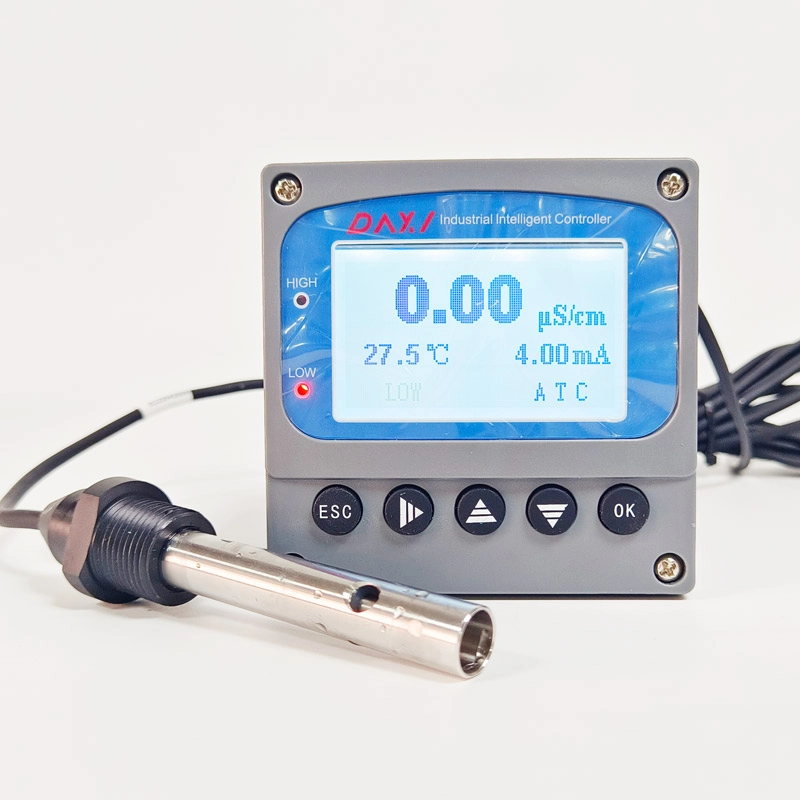
Industrial conductivity meters, such as the DAXIN EC-6801, feature high-precision temperature compensation systems designed for rapidly changing or long-term industrial environments.
Our instruments capture the raw signal from the conductivity electrode while utilizing integrated NTC, Pt100, or Pt1000 sensors to monitor temperature in real-time. The internal algorithms then automatically convert the data to the 25°C standard.
DAXIN solutions support:
- Automatic Temperature Compensation (ATC): Ideal for general industrial water and routine monitoring.
- Adjustable Coefficients: Designed for high-purity water, brine, and specialized chemical processes.
By combining high-accuracy sensors with mature algorithms, DAXIN ensures that your measurements remain consistent and repeatable, providing reliable data support for your water quality and process control needs.